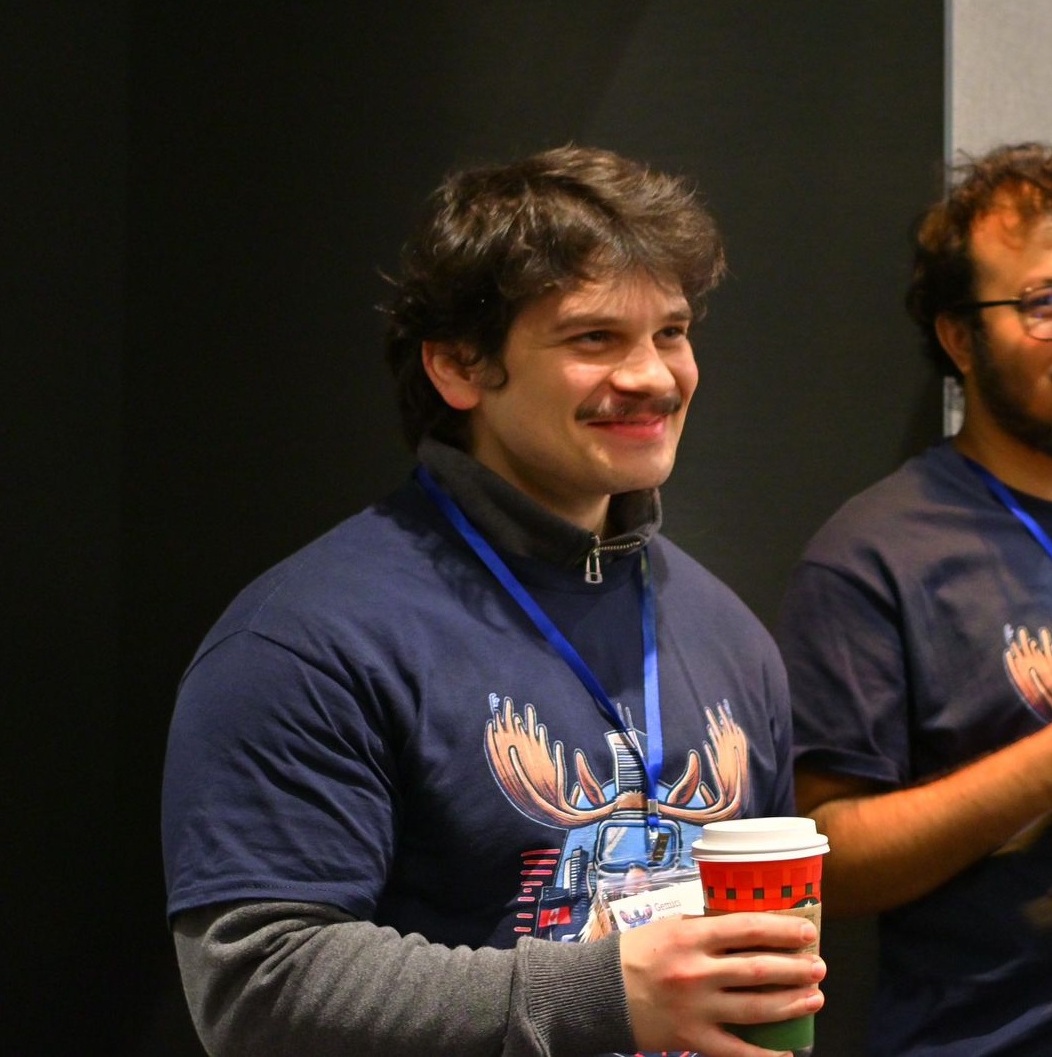
Mucahit Gemici

Mucahit Gemici

Ph.D. Candidate in Computer Science @ Concordia University

Open to postdoc, faculty, and industry research positions starting in 2027.

Research Interests

  • Cross-Reality Systems
  • Human-Computer Interaction
  • Virtual Reality
  • Augmented Reality
  • 3D & Mid-Air Interaction
  • Hybrid User Interfaces
  • AI-Assisted Interaction
  • Game Technologies

Latest Updates

Oct 2026

Submitted my Ph.D. thesis. The defense is scheduled for December 7, 2026.

Oct 2026

Presented two papers at IEEE ISMAR 2026 and ACM SUI 2026 in Bari, Italy.

Aug 2026

Received the Concordia Conference and Exposition Allowance (CAD $2,000) to present at ACM SUI 2026 and IEEE ISMAR 2026.

Jul 2026

Paper accepted to IEEE TVCG (ISMAR 2026 Special Issue): "Modeling Across Realities (MAR)..."

Jul 2026

Co-authored paper accepted to IEEE TVCG (ISMAR 2026 Special Issue): "Effects of False Positive and False Negative Early Warnings..."

Jul 2026

Paper accepted at ACM SUI 2026: "Crossing Realities Has a Cost..."

Jun 2026

Started as a visiting researcher at NAIST, Japan, supported by the Mitacs Globalink Research Award.

Nov 2025

Successfully presented my Ph.D. proposal.

Oct 2025

New paper published: "Landing Windows Method..." at ACM SUI 2025.

Oct 2025

New paper published: "Gaze Analysis..." at IEEE Access.

Jun 2025

New paper published: "Before hands disappear..." at PLOS ONE.

Apr 2025

Successfully passed my Ph.D. comprehensive exam.

Oct 2024

New paper published: "Object Speed Control..." at ISMAR.

Jan 2024

Started Ph.D. education at Concordia University.

About Me

I am a Ph.D. candidate in Computer Science at Concordia University, supervised by Dr. Anil Ufuk Batmaz, with a background in Electrical & Electronics Engineering and mobile game development, where I shipped five games. My research in Human-Computer Interaction asks how Extended Reality (XR) can become part of real work: how headsets can work together with the desktop, keyboard, and mouse instead of replacing them, and how hand input can be made precise and reliable.

On December 7, 2026, I will defend my thesis, One Workspace, Two Realities: Extending Desktop 3D Modeling with Augmented Reality and Artificial Intelligence. It shows how the desktop, AR, and an AI assistant can work together on one shape: editing stays at the desktop with the keyboard and mouse, where it is precise, while AR shows the shape in the space around the user, where they can inspect it, select its parts, and show the assistant what to change. The thesis resulted in publications in IEEE TVCG (presented at ISMAR 2026) and ACM SUI 2026, and two submissions to the International Journal of Human-Computer Interaction (IJHCI). Beyond the thesis, I worked on hand-tracking failures in VR in a Google-funded project that resulted in publications in PLOS ONE and IEEE Access, and a submission to IEEE VR 2027. As a visiting researcher in Prof. Kiyoshi Kiyokawa's Cybernetics and Reality Engineering (CARE) Laboratory at NAIST, Japan, I also built an assistance system for everyday use on lightweight smart glasses.

I am currently looking for postdoctoral, faculty, and industry research positions, starting in 2027.